
Retail shrinkage, the loss of inventory from theft, error, or damage, impacts profitability. For specialty retailers, such as beer distributors, fireworks stores, and multi-location pet supply chains, these losses can erode margins. Implementing retail loss prevention strategies is a business function, not an optional expense. Controls protect assets, ensure financial reporting, and create a secure environment for employees and customers.
This guide presents 10 strategies that retailers can implement to protect assets and improve financial outcomes. We will move beyond advice to provide specific steps for securing your business operations. The focus is on creating a framework that addresses the primary sources of inventory loss.
We will cover controls for inventory and point-of-sale systems, structured employee training programs, and physical store security measures. Each strategy includes implementation details and shows how a POS system provides the data, workflows, and controls to execute these plans. For retailers managing complex inventory or regulated products, such as those migrating from older systems like QuickBooks POS, these integrated tools are fundamental. This article offers a roadmap to reduce shrink by covering:
- Real-Time Inventory Tracking: Gaining control over stock levels.
- POS System Integrity: Securing transactions at the point of sale.
- Employee Accountability: Establishing policies and training.
- Store Security: Optimizing layout and surveillance.
- Audit Procedures: Creating a system for checks and investigations.
- Compliance Controls: Managing age-restricted or regulated product sales.
1. Real-Time Inventory Tracking and Stock Level Monitoring
A foundational retail loss prevention strategy is maintaining real-time visibility of stock across all locations. This approach uses an integrated inventory management system to track products from receiving to the point-of-sale transaction. It works by comparing recorded stock levels against physical counts, flagging discrepancies that could indicate theft, damage, or administrative errors.
This method is critical for multi-location businesses, especially those with high-turnover products like bottle shops and pet stores, where shrinkage can erode margins. Real-time data allows managers to address inventory issues proactively rather than discovering losses during annual counts.
Implementation in Practice
- Beer Distributors: Use cycle count features weekly to reconcile high-value craft beer inventory and catch shrinkage patterns. This level of control is essential for managing a complex product mix. Explore how Pomodo’s POS and inventory management software can streamline these operations for your beer store.
- Multi-Location Pet Retailers: Sync inventory across all stores to prevent stockouts of popular items and detect theft trends that may be isolated to a specific location.
- Fireworks Retailers: Track high-value SKUs through the sales cycle during seasonal peaks, ensuring every item is accounted for from delivery to checkout.
Actionable Tips for Success
To implement this strategy, establish a cycle count schedule. Audit high-shrink items weekly and other products monthly. Train staff on barcode scanning techniques at the POS and during receiving to ensure transaction accuracy. Review variance reports to identify patterns and address root causes, whether they are related to theft, supplier shorts, or internal process failures. Utilize purchase order and transfer features within your POS to maintain auditable inventory records.
2. Point-of-Sale System Controls and Transaction Integrity
A retail loss prevention strategy involves implementing controls within your Point-of-Sale (POS) system to ensure transaction integrity. This approach focuses on restricting operator capabilities based on assigned roles, requiring manager approval for actions like unauthorized discounts, price modifications, refunds, and voided sales. It works by creating a checkout environment where every transaction is transparent and auditable, reducing opportunities for internal theft and fraud.

This method is effective in retail environments where cashiers handle a large volume of transactions, making it difficult to manually supervise every action. By embedding controls directly into the POS workflow, businesses can prevent fraudulent activities before they occur, protecting both revenue and inventory.
Implementation in Practice
- Bottle Shops: Restrict cashiers from applying discounts without a manager’s PIN or swipe card override, preventing “sweethearting” during peak hours.
- Pet Retailers: Require owner or manager approval for all refunds processed without a receipt or for amounts exceeding a threshold like $50. This control helps prevent refund abuse and fraudulent returns.
- Fireworks Stores: Lock down price modification capabilities for cashiers during high-demand seasonal periods, ensuring that every high-value item is sold at its correct price.
Actionable Tips for Success
To deploy this strategy, first establish documented policies regarding discounts, returns, and voids. Use your POS system’s role-based permissions to create profiles for cashiers, shift leads, and managers, hiding or disabling functions that are not essential for their roles. Review void, refund, and discount reports daily to identify unusual patterns or specific employees with high exception rates. It is also important to secure your checkout hardware and learn more about safeguarding against credit card scams to create a security posture. Test your POS controls regularly to confirm they function as intended.
3. Employee Screening, Training, and Accountability Programs
A human-focused retail loss prevention strategy begins with hiring practices and extends through training, policies, and accountability measures. This approach recognizes that internal theft is a source of retail shrinkage. By fostering a culture of integrity and transparency, businesses can reduce internal loss by addressing behavioral issues proactively and setting expectations from day one.
This method is crucial for any retailer but especially for businesses with high employee turnover or those handling valuable, regulated, or age-restricted products. It shifts loss prevention from a reactive, security-based function to a proactive, culture-driven initiative where every team member understands their role in protecting company assets.
Implementation in Practice
- Bottle Shops: Implement training on the handling of high-value inventory, age verification procedures, and policies governing employee discounts to prevent both theft and compliance violations.
- Pet Retailers: Link team bonuses or recognition programs to monthly inventory accuracy metrics, creating a sense of ownership and peer accountability for shrink reduction.
- Fireworks Stores: Conduct background checks for all seasonal and permanent employees who handle high-value, regulated products to minimize risk.
Actionable Tips for Success
To implement this strategy, start with pre-employment screening and documented background checks for all candidates in sensitive roles. Conduct loss prevention training during onboarding and refresh it annually. Use POS reports, like those available in Pomodo, to review transaction voids, returns, and discounts by employee to identify patterns. Address discrepancies or suspicious behavior promptly and fairly according to a documented policy. Finally, celebrate inventory accuracy wins and team successes to reinforce behavior and build a trustworthy store environment.
4. Barcode Scanning and Labeling Standards
A systematic approach to barcode labeling and scanning is a core component of retail loss prevention strategies. This method ensures every product is labeled with a unique barcode and scanned at all transaction points, from receiving to the final sale. It works by eliminating manual price entry, which is a source of human error and “sweethearting,” where staff intentionally undercharge for products.
This standard is effective for specialty retailers with a high volume of SKUs or complex product variations. For businesses like beer distributors or pet stores, consistent scanning ensures that margin integrity is maintained on every item, preventing the drain on profitability caused by pricing mistakes and missed scans.
Implementation in Practice
- Beer Distributors: Create unique barcodes for every package configuration, including singles, 6-packs, and cases. This allows for sales tracking and prevents a cashier from selling a full case at the price of a 6-pack.
- Pet Retailers: Use custom barcodes for in-house private label products or bulk items sold by weight. This formalizes the pricing and inventory tracking for goods that lack a manufacturer-supplied barcode.
- Fireworks Retailers: Generate and apply custom, durable barcodes to high-value assortments and individual items. This ensures every product is scanned during hectic seasonal rushes, preventing revenue loss.
Actionable Tips for Success
To implement barcode standards, start by creating a labeling policy for all incoming products. Train all staff that every transaction must involve a scan; no manual price lookups or entry should be allowed. Use your POS system’s features to require scans for certain items and regularly audit transaction logs to flag any overrides or key-ins. Establish a process for handling products with missing or unscannable barcodes before they reach the sales floor.
5. Merchandise Display and Store Layout Optimization
A retail loss prevention strategy involves the design of your store layout and merchandise placement. This approach organizes the physical space to enhance visibility for staff and create deterrents to theft. It works by positioning high-value or frequently stolen items in high-traffic, observable areas, such as near the point-of-sale, while ensuring the store layout maintains sightlines and avoids creating blind spots.

This method is effective for specialty retailers where product value and shrinkage risk are concentrated in specific SKUs. By controlling the environment, you make opportunistic theft more difficult and less likely to occur without intervention or observation from employees. The layout itself becomes part of your security plan.
Implementation in Practice
- Bottle Shops: Place high-end craft beers, spirits, and allocated liquors on shelves directly behind the register or within view of the checkout area to reduce grab-and-run incidents.
- Pet Retailers: Use locked glass cases for small, high-value products like premium CBD supplements, grooming tools, or specialty animal health items. This controls access while still allowing for product visibility.
- Fireworks Stores: Keep high-demand, high-value aerials and multi-shot cakes behind the service counter during peak sales periods, requiring staff assistance for purchase and minimizing customer handling of inventory.
Actionable Tips for Success
To execute this strategy, first analyze your loss data to identify high-shrink products and store locations. Position these high-margin, high-theft items within six feet of the register or in another monitored zone. Use locked showcases for smaller, concealed products, even if their retail price is under $50, if shrinkage rates are high. Maintain sightlines by keeping endcap displays low and removing large signs or fixtures that obstruct views. Train employees to monitor these designated high-risk areas during their shifts. Finally, review your store layout’s effectiveness quarterly by comparing current shrinkage trends against historical data.
6. Video Surveillance and Monitoring Systems
A component of any retail loss prevention strategy is the installation and maintenance of security cameras throughout the retail environment. This method serves as both a deterrent to theft and a tool for documenting incidents and investigating discrepancies. Surveillance systems provide high-definition footage of key areas and can be integrated with POS data to correlate on-screen transactions with real-world activity, making it a tool for identifying sources of shrinkage.
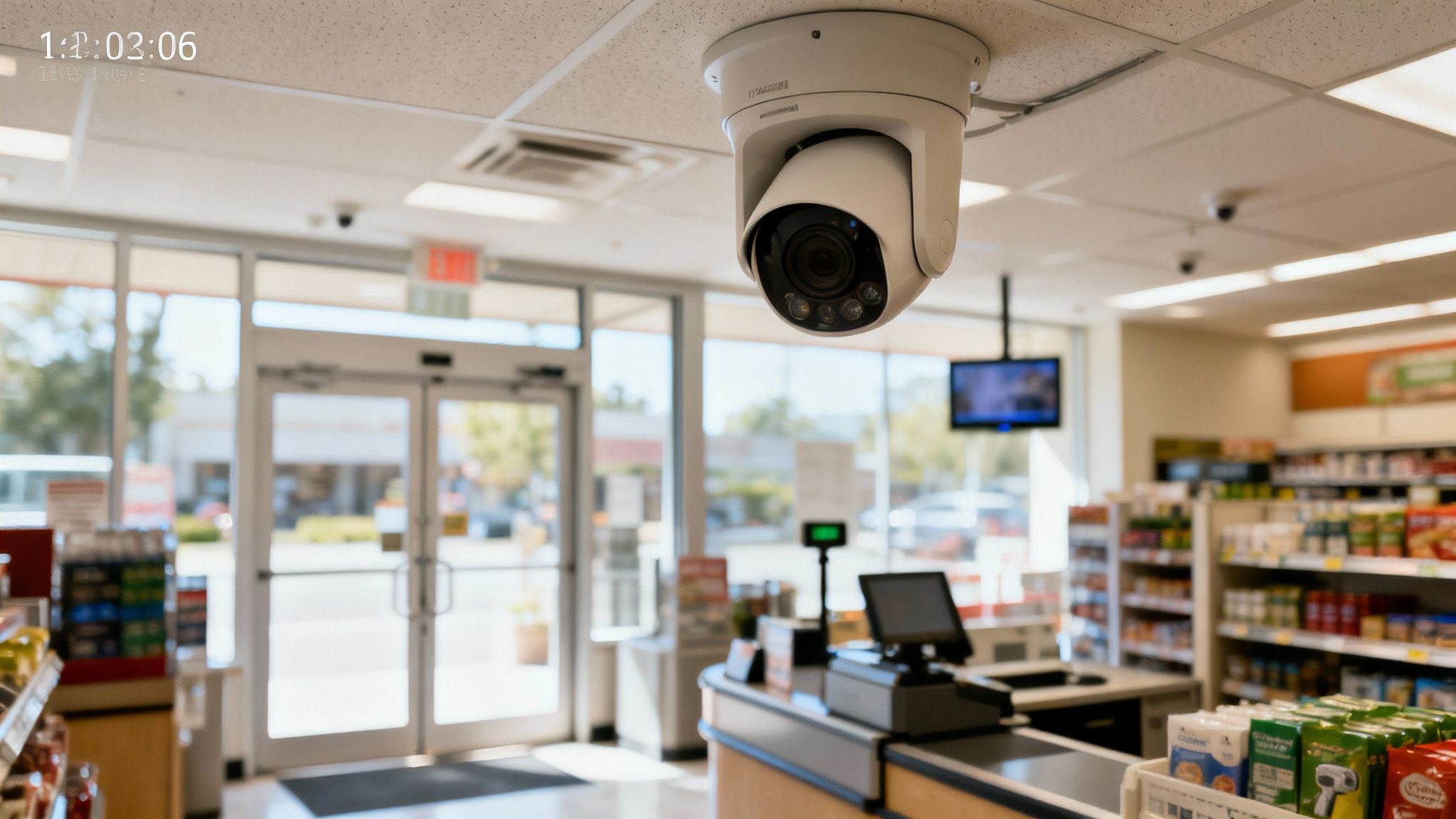
This strategy is valuable for businesses with high-value merchandise or cash transactions, such as bottle shops and specialty retailers. The ability to review recorded footage provides evidence when investigating inventory variances or cash drawer shortages, moving from suspicion to analysis. For multi-location businesses, networked systems offer centralized oversight to maintain security standards.
Implementation in Practice
- Multi-Location Bottle Shops: Use networked cameras to monitor checkout areas and backrooms across all stores, helping to detect cashier discrepancies and internal theft patterns.
- Pet Retailers: Review footage when a cycle count reveals that inventory variance exceeds a set threshold (e.g., 2%) to pinpoint whether the loss is due to shoplifting, employee theft, or receiving errors.
- Fireworks Stores: Maintain high-quality, continuous recording during peak seasonal periods to ensure compliance with regulations and provide documentation for any incidents or loss events.
Actionable Tips for Success
To maximize the effectiveness of video surveillance, install cameras at checkout focused on the POS screen, payment methods, and cash register area. Position additional cameras at all exits, entrances, and over high-shrink merchandise sections. Ensure lighting so footage is clear and usable for investigations. Establish a footage retention policy, with a minimum of 30-60 days. Correlate footage review with discrepancy reports from your POS system to investigate specific incidents. Finally, post visible signage indicating surveillance to enhance the deterrent effect.
7. Receiving and Receiving Controls
A portion of retail shrinkage originates at the receiving dock, making receiving controls a retail loss prevention strategy. This involves implementing standardized protocols for accepting all incoming merchandise, whether from vendors or internal transfers. The function is to verify that the products received match the purchase order in quantity, type, and condition before they are officially entered into the inventory system.
This process is the first line of defense against vendor fraud, short shipments, and receiving damaged goods that cannot be sold. For specialty retailers like beer distributors or pet stores that manage perishable or fragile items, receiving is critical to protecting profit margins. It ensures you only pay for and stock inventory that is accurate and saleable.
Implementation in Practice
- Beer Distributors: Verify case counts, keg dates, and product condition against the purchase order upon every delivery. Use a system to immediately flag any discrepancies with the vendor before the driver leaves.
- Pet Retailers: Check incoming bags of food for damaged packaging, spoiled products, or incorrect SKUs. This prevents unsaleable goods from entering the sales floor and causing customer issues.
- Multi-Location Fireworks Retailers: Utilize purchase order and transfer features to create a audit trail for goods moving between locations, ensuring every item is accounted for during transit and upon arrival.
Actionable Tips for Success
To execute this strategy, create a standardized receiving checklist that is used across all locations. Use your POS system’s purchase order features to digitally match incoming goods against expected deliveries, automating variance detection. Designate a specific, trained staff member to handle receiving, and have them document all discrepancies, photographing damaged items as evidence. Scan barcodes on received items immediately to tie the new inventory to specific deliveries for better tracking. Establish procedures for returning damaged or short-shipped goods to vendors and review receiving discrepancy reports weekly to identify patterns.
8. Customer Refund and Return Policies with Documentation
A retail loss prevention strategy involves creating documented customer refund and return policies. This approach establishes guidelines for how returns are processed, aiming to prevent both customer and employee fraud while maintaining a positive customer experience. It works by setting rules, such as requiring receipts and defining specific time windows, which are then enforced through the Point of Sale system.
This method is crucial for any retailer, as the returns counter is a point for shrinkage. Without a documented process, businesses are vulnerable to fraudulent returns of stolen merchandise, items purchased elsewhere, or used goods. A defined policy empowers staff to handle these situations consistently and provides a defensible position when refusing a fraudulent return.
Implementation in Practice
- Bottle Shops: Implement a policy that only allows returns on unopened products within seven days of purchase, with a mandatory receipt. This prevents the return of consumed or tampered goods.
- Pet Retailers: Require a manager’s condition assessment for returns on opened food or supplements, protecting against fraud while accommodating customer issues with product quality.
- Specialty Retailers: Use POS features to flag multiple returns from the same customer within a short period, alerting management to potential organized retail crime or policy abuse.
Actionable Tips for Success
To use this strategy, first document your refund policy and post it visibly at the POS and on your website. Train all staff on its firm and courteous application. Utilize your POS system to require a receipt lookup for every return, eliminating exceptions. Review refund and exchange reports weekly to identify unusual patterns, such as a high volume of returns processed by a single employee or for a specific product. This vigilance makes your return policy a tool in your overall retail loss prevention strategies.
9. Audit Schedules and Variance Investigation Procedures
An component of retail loss prevention strategies is establishing a formal system of regular audits and procedures for investigating discrepancies. This proactive approach involves systematic checks of inventory and transactions to verify that internal controls are effective. It shifts loss prevention from a reactive annual event to an ongoing operational discipline, identifying where loss occurs so corrective action can be taken immediately.
This method provides continuous verification, ensuring that processes like receiving, sales, and transfers are executed correctly. For retailers with high-value or high-turnover goods, such as specialty beverages or pet supplies, this systematic review is critical for protecting profit margins from incremental shrinkage. It turns inventory data into a tool for operational improvement.
Implementation in Practice
- Beer Distributors: Conduct weekly cycle counts on high-shrink SKUs like premium spirits and limited-release craft beers to quickly spot theft or receiving errors.
- Pet Retailers: Perform monthly audits on high-value product categories like premium pet food or advanced pet care technology. They investigate any inventory variance over a predetermined threshold, for example, 2%.
- Multi-Location Retailers: Use POS and inventory reporting to compare shrinkage rates across different locations. This helps identify outlier stores that may require additional training, security, or management oversight.
Actionable Tips for Success
To execute this strategy, create a variance threshold (e.g., any discrepancy over 3% triggers a formal investigation). Use cycle count and reporting features within your POS to automate audit scheduling and data collection. Assign investigation responsibility to managers, not the staff members whose work is being audited, to maintain objectivity. Document all findings and corrective actions taken to build an audit trail. Differentiate between clerical errors, damage, and suspected theft during root cause analysis to apply the right solution. Review audit trends monthly to identify emerging problems before they become significant.
10. Age Verification and Compliance Controls for Regulated Products
For businesses selling regulated items, a loss prevention strategy involves systematic controls for age-restricted products. This approach integrates compliance directly into the point-of-sale workflow, creating a mandatory process for verifying customer age for items like alcohol, fireworks, or specific pet medications. It works by triggering prompts at checkout that require staff to scan an ID or manually confirm and record that they have verified the customer’s age, preventing illegal sales that can result in fines, license revocation, and brand damage.
This strategy is not just about avoiding legal penalties; it’s a safeguard against the liabilities associated with non-compliance. For retailers like beer distributors or fireworks outlets, failure in this area represents an existential threat to the business. Automating these checks ensures that compliance is a documented part of every relevant transaction, rather than relying solely on employee discretion.
Implementation in Practice
- Beer Distributors: Utilize POS systems that mandate an age verification prompt for every alcohol sale, requiring the cashier to confirm they have visually checked a valid ID before the transaction can proceed.
- Fireworks Retailers: Implement ID scanning for all purchases, creating an electronic log within the POS that serves as a verifiable record of compliance, which is often required by state or local law.
- Pet Retailers: Apply specific POS controls for prescription medications or controlled supplements, prompting staff to verify a prescription or customer age as required by regulations before completing the sale.
Actionable Tips for Success
To implement this strategy, use your POS to create mandatory verification workflows for all age-restricted SKUs. Train all staff on local age verification laws, acceptable forms of ID, and how to spot fakes. Regularly review exception or void reports to identify any staff members who may be bypassing procedures. Maintain accessible documentation of verification policies and update them immediately when regulations change. Use a dedicated barcode scanner compatible with age verification software to make the process fast and accurate for staff and customers.
10-Point Retail Loss Prevention Comparison
| Strategy | Implementation complexity | Resource requirements | Expected outcomes | Ideal use cases | Key advantages |
|---|---|---|---|---|---|
| Real-Time Inventory Tracking and Stock Level Monitoring | Moderate — system setup and integrations | Inventory software, barcode scanners, network, staff time for cycle counts | Improved accuracy, faster shrink detection, optimized reordering | Multi-location retailers, bottle shops, pet stores with many SKUs | Real-time visibility, data-driven reordering, fewer stockouts/overstocks |
| Point-of-Sale System Controls and Transaction Integrity | Low–Moderate — configure roles and approval workflows | POS with role-based access, manager availability, staff training | Reduced unauthorized discounts/refunds, stronger audit trails | High-velocity checkouts (bottle shops, busy retail) | Prevents internal fraud, accountability via logs, customizable rules |
| Employee Screening, Training, and Accountability Programs | Moderate — establish hiring and ongoing training processes | HR time, background checks, training materials, management enforcement | Lower internal theft, stronger culture, reduced reliance on tech | All retailers, especially with high internal shrink | Proactive prevention, builds trust, deterrent through accountability |
| Barcode Scanning and Labeling Standards | Moderate — initial labeling and standards rollout | Label printers, scanners, staff time to label and train | Fewer missed scans, accurate inventory reconciliation, faster checkout | Specialty retailers with high SKU counts (beer, pet stores) | Prevents undercharging, enables SKU-level analytics, speeds sales |
| Merchandise Display and Store Layout Optimization | Low — repositioning and fixture changes | Store fixtures, locked cases as needed, staff monitoring | Reduced opportunity theft, improved visibility, potential sales lift | Stores with small high-value items or limited staff | Low-cost deterrent, improves natural surveillance, boosts impulse buys |
| Video Surveillance and Monitoring Systems | Moderate–High — camera planning, integration, maintenance | Cameras, recording/storage, installation, monitoring resources | Strong deterrent, evidence for investigations, POS correlation | Multi-location retailers, high-shrink or regulated product stores | Provides evidence, enables remote monitoring, deters theft |
| Receiving and Receiving Controls | Moderate — process and role changes at intake | Receiving staff, PO matching tools, barcode scanning, checklists | Fewer vendor errors, baseline inventory accuracy, chargeback ability | Distributors, frequent-delivery stores, multi-location transfers | Catches issues at source, supports vendor claims, accurate records |
| Customer Refund and Return Policies with Documentation | Low–Moderate — policy drafting and POS enforcement | Staff training, POS return tracking, signage, photo/document tools | Reduced refund fraud, clearer customer expectations, trend data | Stores with frequent or high-value returns | Deters return abuse, consistent enforcement, creates audit trail |
| Audit Schedules and Variance Investigation Procedures | Moderate — schedule audits and investigation workflows | Staff time for audits, reporting tools, investigation documentation | Early loss detection, root-cause identification, corrective action | Multi-location retailers, items with recurring variances | Distinguishes errors vs theft, enables targeted fixes, accountability |
| Age Verification and Compliance Controls for Regulated Products | Low–Moderate — POS prompts and training | ID scanners or manual checks, POS workflows, recordkeeping | Reduced illegal sales, regulatory compliance, reduced liability | Beer distributors, fireworks retailers, regulated pet meds | Ensures compliance, documents verification, protects license |
Integrating Strategies for Comprehensive Loss Prevention
Implementing a series of disconnected tactics will not create a secure retail environment. The most effective retail loss prevention strategies are not standalone solutions; they are interconnected components of a unified system. Asset protection emerges when technology, processes, and people work in concert, creating overlapping layers of security that address shrinkage from multiple angles. The journey from identifying loss to preventing it requires a holistic view, where each strategy supports and reinforces the others.
Consider the relationship between POS controls and inventory management. A transaction void at the register, flagged by your POS system, is an isolated data point. However, when integrated with real-time inventory tracking, it becomes an investigative tool. You can immediately check if the item supposedly “voided” was returned to the shelf or if it left the store. This connection transforms a reactive alert into a proactive control measure.
Key Takeaways for Building a Resilient Operation
To move from concept to execution, focus on these core principles drawn from the strategies discussed. These are the foundational pillars upon which a successful loss prevention program is built.
- Data is Your Foundation: Accurate, real-time data is non-negotiable. Without precise inventory counts and transaction logs, every other effort is based on guesswork. A system that provides this visibility is the starting point for all other retail loss prevention strategies.
- Process Defines Consistency: Defined procedures for receiving, returns, and audits remove ambiguity. When every team member handles these tasks the same way, every time, it becomes easier to spot deviations that signal potential loss.
- Technology is the Enabler: Modern tools, from barcode scanners to integrated POS and inventory platforms like Pomodo Software, are essential. They automate manual tasks, reduce human error, and provide the data needed to make informed decisions. Technology acts as a force multiplier for your policies and your people.
- People are Your First Line of Defense: A well-trained, engaged team is your most valuable asset. Screening, ongoing education about loss prevention, and fostering a culture of accountability turn employees into active participants in protecting the business.
Central Insight: Loss prevention is not a one-time project but a continuous business function. It requires constant attention, regular review, and a commitment to adapting your strategies as new challenges arise and new technologies become available.
Your Actionable Path Forward
Building a comprehensive loss prevention framework can seem daunting. The key is to start with manageable, high-impact steps and build momentum. Do not attempt to implement everything at once. Instead, adopt a phased approach.
- Conduct a Baseline Audit: Before making changes, understand your current situation. Perform a physical inventory count and analyze your historical sales and shrinkage data to identify your most vulnerable products and processes.
- Prioritize Your Top 2-3 Strategies: Based on your audit, select the two or three strategies that will address your biggest pain points. For a bottle shop, this might be tightening age verification controls and implementing real-time inventory tracking. For a specialty retailer, it could be refining receiving procedures and optimizing store layout.
- Leverage Your POS/Inventory Hub: Use your central software platform as the core of your implementation. Configure user permissions, set up transaction alerts, and ensure your inventory and sales data are integrated. This technology is the connective tissue for your new processes.
- Train, Implement, and Measure: Thoroughly train your team on the new procedures. Roll out the changes and immediately begin monitoring the results. Track key metrics like inventory variance, voided transactions, and return rates.
- Review and Expand: After 90 days, review the data. What worked? What needs refinement? Use these insights to improve your initial strategies and then select the next one or two priorities from your list to implement.
By embracing this iterative process, you create a cycle of continuous improvement. Each step builds on the last, systematically closing security gaps and strengthening your operational controls. The goal is not just to reduce a single shrink percentage; it is to build a resilient, profitable business where protecting assets is an integral part of the daily culture. Your bottom line will reflect the effort.